Showing posts with label cockfighting. Show all posts

Tuesday, September 29, 2009

Woodstock Sanctuary Needs Home for 94 Rescued Roosters - Help!

Woodstock Farm Animal Sanctuary took in, via the ASPCA, 94 young
roosters seized from an illegal slaughterhouse in New York City. The
ASPCA mistakenly proclaimed all of the birds to be hens. Woodstock is
DESPERATE to find homes for these birds. Possible homes have been
located for about 14 birds, which leaves 80 ADORABLE young roosters who
need to be adopted.

If you or anyone you know can adopt one or more of these roosters,
please contact:

Jenny Brown, Director
Woodstock Farm Animal Sanctuary
Woodstock, NY 12498
Phone: 845-679-5955
Email: [mailto:jenny@woodstocksanctuary.org]
Website: [http://www.WoodstockSanctuary.org]

Cock-a-Doodle-Doo! Thank you!

--
United Poultry Concerns is a nonprofit organization that promotes the
compassionate and respectful treatment of domestic fowl.
Don't just switch from beef to chicken. Go Vegan.
[http://www.UPC-online.org]

Friday, July 31, 2009

WAYNE PACELLE-HSUS


New Arkansas Felony Animal Cruelty Law Fills Deficit

Posted: 31 Jul 2009 09:52 AM PDT

Today, a strong new anti-cruelty law takes effect in Arkansas, making that state the 46th with felony-level penalties for malicious acts of cruelty (all 50 states already treat dogfighting as a felony). The new law makes the torturing of a dog, cat, or horse a felony on the first offense, and cruelty to animals is punishable with up to six years in prison and a fine as high as $10,000. Cockfighting is now a felony offense, with Arkansas the 39th state to have such a law—an enormous achievement in itself. The bill also elevates a number of lesser cruelty offenses, like neglect, to a felony level crime on the fourth offense, and there is also a provision for a five-year sentencing enhancement in the case of anyone convicted of torturing an animal in the presence of a child. There is funding set aside for training law enforcement officers on interpretation and implementation.

The Arkansas statute is a magnificent achievement and the direct result of serious political investments by its sponsors, State Sen. Sue Madison and State Rep. Pam Adcock, and by Gov. Mike Beebe, Attorney General Dustin McDaniel, and others who recognized the importance of felony-level penalties for calculated cruelty. For years, the Arkansas Farm Bureau and other agricultural interests had stymied the passage of such legislation, but Attorney General McDaniel, in particular, pulled the parties together and would not take “no” for an answer on this legislation.


© The HSUS
One of more than 500 dogs found at the Hanson property.
In an exceptional coincidence, Baxter County, Arkansas Sheriff John Montgomery recently achieved a breakthrough in a case that illustrated the weakness of the existing anti-cruelty statute. On the weekend of July 18, acting on an anonymous tip, Vermont authorities arrested Tammy Hanson, an animal hoarder who fled Arkansas in February 2006 after she and her husband were convicted on 20 misdemeanor counts of cruelty. Sheriff Montgomery went to Vermont to appear at an extradition hearing, acting on behalf of Lawrence County, Missouri, where Hanson faces charges of animal cruelty and neglect in another case, and his own jurisdiction.

We expect Sheriff Montgomery to succeed in his efforts to extradite Hanson to face the penalties for her crimes as well as her contempt for the legal process. It’s worth noting that the maximum sentence she’ll face is $1,000 and up to a year in prison. If she had been charged under a felony-level statute like the one taking effect today, Hanson would have been subject to a penalty truly commensurate with her misdeeds, and it would have been a good deal easier to secure her extradition.

The Hanson case was the focus of a major HSUS emergency response in the aftermath of Hurricane Katrina in October 2005. The Hanson property in Gamaliel, Ark. was an inferno of misery for animals, masquerading as a sanctuary. The Baxter County Sheriff’s Department invited responders from The HSUS and United Animal Nations to set up an emergency operation to shelter and care for more than 500 dogs in various stages of suffering and neglect. For the animals involved, at least 100 of whom were displaced Katrina victims, there were many happy endings, but not before we spent more than $100,000 and completed a full deployment of personnel including then program staffer Tammy Hawley, HSUS consultant Kim Staton, and current Arkansas State Director Desiree Bender, all of whom particularly distinguished themselves in this situation.

To the extent that the Hanson case became Exhibit A for the necessity of a felony-level statute in Arkansas, one that would truly deter cruelty in the state, it was worth every measure of toil, sweat, and funds to meet the demands of the situation. But it’s a greater satisfaction to know that, as of today, the mistreatment of animals in Arkansas, whether by hoarders, puppy millers, cockfighters or others, will be met with a stronger measure of justice, one that is backed by a full array of law enforcement and public officials in the state.

Sunday, July 19, 2009

Arizona Legislature Bans All Animal Fighting and Horse Tripping

The Arizona Legislature passed a bill that outlaws all animal fighting and
horse tripping. Senate Bill 1115 passed the Legislature with only one
opposing vote in each chamber (Sen. Jack Harper; Rep. Andy Biggs voted “no”).
The bill was then signed into law by Governor Brewer. Please thank the
Governor, your two House members, and Senator for passing this important
animal protection measure (contact information below)
Bill Information
For the first time in the Arizona Legislature, a bill addressing one
animal issue was successfully expanded to include various other animal
protection provisions. SB 1115, animals; fighting (Sen. Paton, Rep. Young Wright)
expands to all animals, the offense of dog fighting, presence at a dog fight,
and theft of a dog for the purpose of fighting. The measure provides an
effective tool to stop hog-dog fights, where a trained dog attacks a wild hog
in a pen, causing severe or fatal injuries.
SB 1115 also outlaws the cruel sport of horse tripping which involves
lassoing the front legs of a galloping horse, causing the animal to trip and
fall, often with fatal results. This Mexican rodeo event is banned in
several states including California and New Mexico, and recently was outlawed in
the city of Phoenix.
Additionally SB 1115 provides county officials authority to inspect dog
kennels if a written complaint is filed alleging animal cruelty or dog
fighting. The bill also requires the Arizona Department of Agriculture to
establish a registry of equine rescue facilities.
SB 1115 was passed with overwhelming bipartisan support and sponsorship.
The bill was supported by a diverse group including law enforcement
agencies, animal welfare organizations, Mexican rodeo facility owners, and hunting
and ranching interests. ADLA appreciates the efforts of all who made this
historic animal protection measure a reality. The new law will provide
important tools for addressing animal cruelty issues, which affect not only
the victims but entire communities.

Thursday, June 25, 2009

LIVE CHICKENS SOLD IN SEALED BAGS-LETTERS NEEDED!

Live Chickens Sold in Sealed Bags by San Francisco Markets
Law Enforcement Turns Blind Eye - Letters Are Urgently Needed!
http://www.upc-online.org/livemarkets/sf_market_raymond_young.jpg
Animal advocacy investigators in San Francisco, California havedocumented extreme cruelty to chickens and other birds being sold tocustomers by San Francisco's live animal vendors. The website, "AnimalAbuse at San Francisco Farmers' Markets," explains the situationincluding links to recent TV coverage, with more coverage expected:
http://www.lgbtcompassion.org/livemarkets/livemarkets.htm
Click on the above link for the full report, including who to write toand what to say in your letter. Please keep checking this website forupdates. This is an ongoing investigation of horrendous and illegalcruelty to helpless birds in San Francisco, facilitated by SanFrancisco's Animal Care & Control office's failure to enforceCalifornia's animal cruelty laws. Singled out for egregious, exemplarycruelty to chickens by the investigators are: Raymond Young's market atUN Plaza in the Civic Center, and New Longs live poultry market in theparking lot of Good Hope Baptist Church near the Alemany Blvd farmersmarket.
Although California law 599b defines "animal" to include "all dumbanimals" without exception for protection, and cruelty to all animals isprohibited under the California Penal Code's "Animal Welfare Provisions,Section 597. Cruelty to Animals," an exception appears in Section 597.3on live animal markets, where "Animal" is arbitrarily defined to mean"frogs, turtles, and birds sold for the purpose of human consumption,with the exception of poultry."
This means that birds such as quails and partridges sold at the markets(and treated horribly by the vendors) are classed separately fromchickens, turkeys, ducks and geese, commonly defined as "poultry" by theU.S. Department of Agriculture.
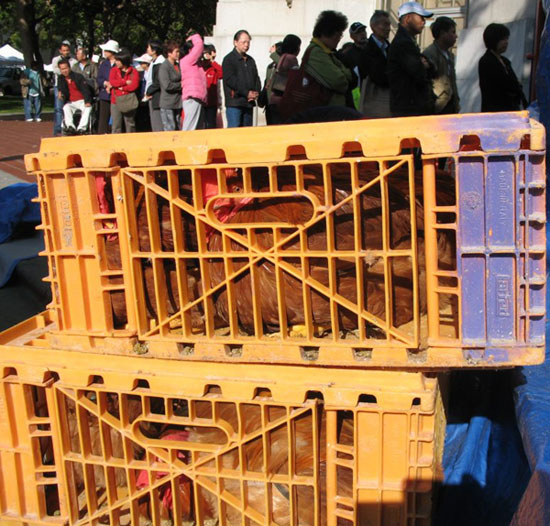
So-called "spent" hens and roosters ("poultry") are particularlyvictimized by the vendors, who stuff them upside down into paper orplastic bags - or paper bags inside plastic bags - for customers to takehome, "often in their car trunks, after carrying them around shopping,"to kill as they please for food, ritual sacrifice or cockfighting.
Customers also carry the live birds illegally sealed up in bags ontobuses and rapid transit trains (MUNI & BART), and live birds are held inrestaurants to be "fresh-killed" for restaurant patrons - a violation ofSan Francisco's Department of Health Code 050, which states that "Nolive bird or fowl shall be kept or allowed in a food facility."
Please click on http://www.lgbtcompassion.org/livemarkets/livemarkets.htm
and get involved! This link can also be found in UPC's Live PoultryMarkets section of our website at http://www.upc-online.org/livemarkets/
Thank You for Helping These Birds!
--United Poultry Concerns is a nonprofit organization that promotes thecompassionate and respectful treatment of domestic fowl.Don't just switch from beef to chicken. Go Vegan.
http://www.UPC-online.org

Order Prisoned Chickens, Poisoned Eggs Today![
http://www.upc-online.org/merchandise/book.html

Sunday, June 14, 2009

MAJOR HSUS EXPOSE ON COCKFIGHTING IN KENTUCKY

http://www.kentucky.com/news/state/story/829267.html
Secret video shows revival of cockfighting in Kentucky
By Greg Kocher
JEFFERSONVILLE -- Four years after police raided and shut down a Montgomery County cockfighting operation, the arena is back in business and under new ownership.
What was once called Spring Brook Farm is now the Bayou Springs Club near Jeffersonville, about 7 miles southeast of Mount Sterling. In late May, the 700-seat arena hosted what a schedule of events billed as the "World Championship."
Investigators for the Humane Society of the United States each paid a $20 admission fee to the event. Once inside, they secretly recorded video of specially bred roosters fighting each other inside rings while dozens of spectators watched.
Cockfighting is illegal in all 50 states and is a felony offense in 39. Animal rights activists contend that Kentucky's second-degree animal-cruelty law makes cockfighting a misdemeanor punishable by up to 12 months in jail and $500 fine, but some have interpreted it differently.
In cockfights, the roosters sometimes fight with sharp knives or with spurs that look like curved ice picks, called gaffs, fastened to their legs; the weapons are used to scratch, cut, maim and kill their opponents.
The Humane Society is gathering information to seek legislation that would make cockfighting a felony offense in Kentucky.
Some don't see the point in that.
Jeffersonville Mayor Anthony Henderson said there are "a lot worse problems out there than somebody cockfighting," and said it should be legalized so it could be taxed. He equated it with the Kentucky legislature's current consideration to put video lottery terminals or slots at horse racing tracks.
"I'm not trying to take up for the cockfighter," Henderson said. "But if they're going to go out here and legalize slot machines, and take money from a poor person that can get addicted to something, I don't know why in the world they can't legalize cockfighting and tax the dollars off it.
"In the economy that we've got right now, with a billion-dollar budget shortfall for the commonwealth of Kentucky ... it might be a great thing for the legislators to pass a bill on that and just tax that," Henderson said.
State Sen. Tom Buford, R-Nicholasville, said cockfighting and horse racing are two very different things.
"While some may view the race of a 2-year-old as a strain on a horse, many view that as a natural thing for a horse to do without becoming harmed," Buford said. "I think the majority of Kentuckians would view a cockfight as the death of a bird. That's the goal: to kill the other bird."
Richard Abshire, president of the Louisiana company that now owns Bayou Springs, would not talk about what goes on there.
"We've done that before in Louisiana, and it's always come to haunt us," Abshire said.
Asked why he did not want to talk about cockfighting, he said: "The words always get twisted and everything, and before you know it, the representatives end up passing something against it."
Abshire, 35, was charged in March after Louisiana State Police raided the Little Bayou Club, a cockfighting pit in Sulphur, La., said police spokesman Sgt. Stephen La Fargue. That raid -- the first since Louisiana's cockfighting law went into effect in 2008 -- seized 635 birds as well as cockfighting implements.
Abshire, who is out on bond, was charged with two counts of illegally gambling and wagering on cockfights, LaFargue said. Abshire's case has not gone to trial.
Diana Morales, public relations/community outreach director for animal services in Calcasieu Parish, said Louisiana State Police told her that Abshire was preparing an operation in Kentucky.
"They knew about Kentucky and had been in touch with Kentucky authorities," Morales said.
A poultry show
Abshire called the Montgomery County World Championship event "a poultry show" in which gamecocks are merely displayed and judged.
"There's absolutely nothing wrong with that," he said. "It was all the big major breeders who can come and sell their stuff."
But video recorded by a private investigator for the Humane Society of the United States on May 31 and shared with the Herald-Leader shows an audience watching gamecocks in a pit with two handlers and a referee. The roosters repeatedly jump into the air, flapping their wings and attacking each other.
Tom Farrow, a retired FBI agent who is now an investigator for the Humane Society, said he counted more than 160 people in attendance at Bayou Springs on May 30, and saw parked vehicles bearing license plates from Texas, New Jersey, Arkansas, West Virginia and Tennessee. The crowd on May 31 was slightly smaller, he said.
Farrow said he saw two roosters at Bayou Springs fighting for 40 minutes, one of the longest-running cockfights he'd ever witnessed.
"The guy next to me was like, 'C'mon! It's done! It's done! Call a winner!'" Farrow recalled. Finally, he said, a referee declared one bird the winner after its opponent keeled over.
"It was still alive, but it was just exhausted," Farrow said.
The arena had stadium seating, a public address system, scoreboards and a restaurant that sold gumbo and burgers. Souvenir T-shirts that depicted gamecocks were for sale and could be personalized with the buyer's name.
Although signs posted in the building said gambling was prohibited, Farrow said he saw bettors with wads of cash and others soliciting bets. The largest wager Farrow heard was for $500.
"There were a couple of guys sporting some pretty big rolls of money in there," Farrow said.
A boost to the county
Marvin Watkins of Jeffersonville built the 700-seat arena on Long Branch Road in 1992. It operated for years with the knowledge of many in and around Jeffersonville, a city of about 1,900 residents.
Mayor Henderson said the arena in the past was an important part of the local economy as it attracted hundreds of out-of-town visitors.
"When Spring Brook had an event going on, you couldn't find a motel room from Winchester on," Henderson recalled. "I am sitting here telling you that the businesses around there stayed full, the restaurant areas, the gas pumps. It absolutely boosted Montgomery County."
(Henderson said he was unaware that events had resumed at the arena.)
In April 2005, Kentucky State Police raided Spring Brook, charged Watkins and his wife with running a criminal syndicate, and cited 507 spectators with animal-cruelty. Some of those cited came from as far away as California, Ontario and Guam.
But Montgomery County District Judge William Lane threw out the charges against the spectators, saying the animal-cruelty law was unclear.
A clause in the law refers to spectators and vendors "at an event where a four (4) legged animal is caused to fight for pleasure or profit."
Chickens have only two legs, the judge noted in a ruling filed in August 2005 in Montgomery District Court.
In July 2006, Marvin Watkins pleaded guilty to a lesser charge of conspiracy to promote gambling. Under the plea agreement, his two-year sentence was probated for five years. A similar charge against his wife, Charlene, was dropped.
The couple also had to rid their farm of all cockfighting materials, including pits and cages. State police kept $171,000 in fees paid by entrants the day of the raid. Another $257,038 went to the Internal Revenue Service and/or the Kentucky Revenue Cabinet.
Fast forward to November, when the Watkinses sold nearly 8 acres, the arena, a mobile home and a garage for $550,000 to a company called Bubab LLC, whose mailing address is in Vinton, La., according to a deed in the Montgomery County Clerk's office and a property card in the Montgomery County Property Valuation Administrator's office.
The deed listed Bubab's president as Richard Abshire, whose name is also on an April application to operate a restaurant at Bayou Springs filed with the Montgomery County Health Department.
Why should anyone care?
The Montgomery County arena is among sites in Alabama and Tennessee that are under investigation by the Humane Society.
As states have passed laws with stronger penalties for cockfighting, operators have set up shop in states like Kentucky with weaker laws, said John Goodwin, manager of animal fighting issues for the Humane Society.
For example, a cockfighting pit in Pound, Va., moved to Jenkins in eastern Kentucky after the Virginia legislature made cockfighting a felony, Goodwin said. The Humane Society has identified other cockfighting pits in Floyd and Laurel counties, and estimates there are many more throughout the state.
While cockfighters and others say it is a waste of money and resources to prosecute the practice, Farrow said other problems are often associated with cockfighting. He should know. Before retiring from the FBI in 2008, he was the lead investigator in a seven-year federal corruption case in Cocke County, Tenn., that included cockfighting, illegal gambling, drug trafficking and bribes to police.
Where there is cockfighting, there often are drugs, alcohol and guns, although Farrow said he did not see those at Bayou Springs.
Still, it is an illegal activity that has the potential to corrupt law enforcement, Farrow said. He testified to that last year before a Tennessee legislative committee.
"I was floored by some of the questions I got in the (Tennessee) House of Representatives," Farrow said. "Why should anybody care? Why should we strengthen the law?' And my argument then and still is you should strengthen any law regarding corruption in law enforcement because our whole judicial system is destabilized by corrupt activities."